A literary retelling of the complete narrative in Skanda Purana.
When the sun of Trayodashi begins to withdraw its light, when day has not entirely departed and night has not yet fully descended upon the earth, Hindu tradition recognises that sacred interval as Pradosha.
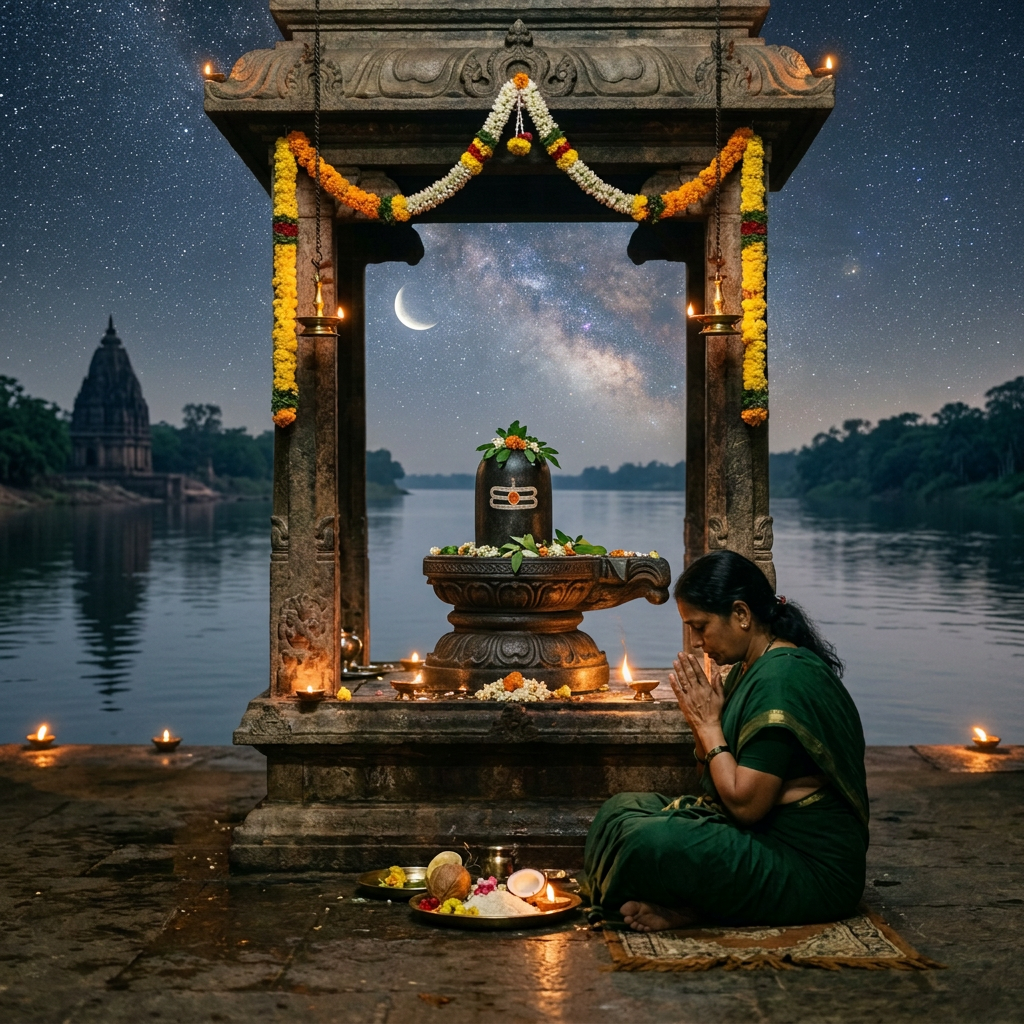
In the Skanda Purana, Pradosha is not merely a calculation of time. It is a special hour of Shiva worship. The evening of Trayodashi is called Pradosha; at this time Mahadeva dances in his silver abode on Mount Kailasa while the Gods praise his virtues. Those who seek Dharma, Artha, Kama and Moksha are enjoined to worship Shiva, perform Homa, listen to Sacred Narrative and sing His Glories during this Sacred Period.
But the Skanda Purana Text does not stop after prescribing Worship.
It asks a Deeper Question.
What happens when the sanctity of Pradosha is neglected? And what happens when a human being—bereft of wealth, position, family and apparent fortune—returns to the refuge of Shiva during this Sacred Hour?
The answer is given through a long and remarkable narrative.
It begins with a king and descends into the helplessness of an orphaned infant. It passes through the home of an impoverished Brahmin widow, reaches the hermitage of Sage Shandilya and finally extends to the Gandharva realm and Kailasa itself.
It is a Journey from a begging bowl back to a royal throne.
This is the Pradosh Vrat Katha of King Satyaratha and his son Dharmagupta.
King Satyaratha of Vidarbha
In the land of Vidarbha there lived a king named Satyaratha.
The Skanda Purana describes him as devoted to righteousness, steadfast, virtuous and true to his word. For a long period he governed the earth according to Dharma and his kingdom prospered in peace.
But prosperity does not remain unchanged for ever.
The kings of the Salva country attacked Vidarbha and surrounded its capital. Satyaratha gathered a great army and entered the battlefield.
A terrible war followed.
Large numbers of the Salva warriors were slain, yet eventually King Satyaratha himself fell in battle. His ministers too were killed, and those soldiers who survived fled for their lives.
In a moment, a kingdom had lost its king.
Yet the future of the royal lineage was still alive—
within the womb of his queen.
The Pregnant Queen Flees into the Night
One of Satyaratha’s devoted queens was pregnant.
Her husband had been slain. The capital was in enemy hands. With the royal house collapsing around her, she left the palace during the night and travelled westward.
Morning came.
She continued slowly along the unfamiliar road until, after covering a great distance, she found a clear lake. A shady tree stood by its bank.
There, in that desolate place, the widowed queen gave birth to a son.
His father was gone.
His kingdom was gone.
But a child of the royal house had been born.
Then destiny delivered another blow.
Exhausted and tormented by thirst after childbirth, the queen entered the lake to drink water.
A great graha, an aquatic creature described in the text as seizing her, made her its prey.
The infant had lost both father and mother almost at the very moment of birth.
Alone on the bank of the lake, hungry and thirsty, the newborn child cried aloud.
At this point, the grandeur of kingship disappears completely from the story.
There is no palace.
No army.
No royal attendant.
Only a newborn child lying upon the earth.
And approaching him is a woman who possesses almost nothing herself.
Uma, the Poor Brahmin Widow: When Compassion Stood Before Lineage
A Brahmin woman happened to arrive there.
Her name was Uma.
She carried her own one-year-old child with her. She was a widow, desperately poor and dependent upon alms collected from house to house for her survival.
Uma saw the abandoned infant.
Even his umbilical cord had not yet been cut.
There was no mother nearby, no father, no relative.
Her maternal heart urged her to pick him up, yet she hesitated because of the social conventions of her age. What was the child’s lineage? How could she touch and adopt him without knowing?
Her compassion told her to lift the child.
Custom held her back.
At that moment a wandering ascetic appeared.
The ascetic appeared as though he were Shiva himself.
He urged Uma to abandon her sorrow and doubt, protect the child and raise him, assuring her that through him she would soon attain great welfare. The compassionate mendicant then departed.
Uma hesitated no longer.
A woman who barely possessed enough to feed her own son picked up another child.
This is the first great illumination in the Pradosh narrative:
Grace sometimes begins in the hands of one who possesses almost nothing.
A Prince Raised on Food Received in Alms
Uma carried the infant home and raised him exactly as she raised her own son.
She lived in a place called Ekachakra. The food obtained through begging sustained both boys. In due course the prescribed rites were performed for them, and later their sacred-thread ceremonies took place. Both boys observed their disciplines and accompanied Uma when she went out seeking alms.
The image is striking.
A child born to inherit a throne now carried the life of a mendicant.
The son of a queen survived on food received in charity.
Royal blood flowed within him, yet poverty had stripped away every visible sign of royalty.
It is at this point that Sage Shandilya enters the narrative.
Sage Shandilya Recognises the Lost Prince
One day Uma and the two boys arrived, while seeking alms, at a temple where elderly sages and ascetics lived.
Among them was the wise Shandilya.
When he saw the royal child, he marvelled at the extraordinary power of Destiny and Karma. He observed how difficult it is for any being to escape the consequences of previous actions, pointing to the strange fate of the boy who now survived on alms under the protection of another mother.
Uma was astonished.
She bowed to the sage and asked:
Who is this child?
In what family was he born?
Who were his mother and father?
Shandilya revealed the truth.
The child was the son of the King of Vidarbha.
His father had been slain in war.
His mother had been seized by the creature in the lake.
Uma now had an even greater question.
If Satyaratha had been righteous, why had he died in such a manner?
Why was a royal prince living in poverty?
How could the boy overcome his destitution and recover his kingdom?
And how could the poverty of her own son be removed?
Shandilya’s answer brings the central doctrine of the Pradosh story into view.
The Previous Birth of Satyaratha and the Interrupted Pradosha Worship
Shandilya explained that Satyaratha, King of Vidarbha in his present birth, had been a king of the Pandya country in a previous life.
He knew the principles of Dharma and governed righteously.
One evening, during Pradosha, he was worshipping Lord Shiva.
Suddenly a great disturbance arose in the city.
Fearing disorder, the king left his Shiva worship incomplete and went out.
At that moment his powerful minister brought before him an enemy feudatory who had been captured.
Anger overtook the king.
He ordered the man’s head to be severed.
The king did not then return to complete the interrupted worship. Nor did he ritually conclude his religious observance. Instead, he ate during the night.
His son likewise ate and went to sleep without worshipping Shiva at Pradosha.
Shandilya linked those actions with their subsequent births.
The Pandya king was born again as Satyaratha of Vidarbha and, because of the disruption and neglect of his Shiva worship, was killed by enemies while still enjoying royal prosperity.
His son from the previous birth was born as his son again, and his failure to honour the Pradosha worship was given as the Karmic reason for his present poverty.
Shandilya also explained the queen’s fate: in a previous birth she had deceitfully caused the death of a co-wife, and the text connects that act with her present death in the lake.
Yet the Purana does not remain with punishment.
The sage turns immediately towards the remedy:
refuge at the feet of Ishvara.
Single-minded worship of Shiva at Pradosha.
Why Uma’s Own Son Was Poor
Uma had also asked about the poverty of her biological son.
Shandilya said that in his previous birth the boy had been a worthy Brahmin, but had spent his life chiefly receiving gifts and had not correspondingly engaged in sacrificial and other meritorious acts.
His present poverty was explained in that Karmic context.
The remedy given to him was the same:
seek refuge in Lord Shiva.
Shandilya Explains the Pradosh Vrat and Shiva Puja
Shandilya says that one should Fast on Trayodashi in both Lunar Fortnights. Three Ghatis before Sunset, the devotee should bathe, put on clean white garments, complete the regular Sandhya and Japa, maintain discipline and silence, and begin the worship of Shiva.
The place of worship should be purified and a Mandala prepared and adorned with flowers, fruits and fresh shoots. After the rites of Purification, Pranayama and Nyasa, the devotee should meditate upon Shiva in the lotus of the heart.
Uma, Daughter of the Mountain, is visualised beside Him.
The worshipper then makes the Sankalpa and invokes Shiva.
The prayer is deeply human.
It seeks freedom from debt, sin, misfortune, poverty, grief, disease and fear of worldly existence.
The rite includes Ablution with water and Panchamrita, followed by offerings such as garments, sacred thread, ornaments, sandal paste, Bilva leaves and available flowers, incense, lamps and food.
Yet in the midst of this elaborate ritual description comes one of the most compassionate teachings in the passage.
If the devotee lacks the wealth or capacity to perform the full worship, he should worship according to his means.
Gauripati Shiva is satisfied even with a single flower when it is offered with devotion.
Here ritual magnificence yields before the interior truth of Bhakti.
A Prayer to Shiva at Pradosha
The worship is followed by praise. The Shiva-stuti associated with Brahmottara Khanda.
जय देव जगन्नाथ जय शंकर शाश्वत।
जय सर्वसुराध्यक्ष जय सर्वसुरार्चित॥
जय सर्वगुणातीत जय सर्ववरप्रद।
जय नित्य निराधार जय विश्वम्भराव्यय॥
Jaya Deva Jagannatha, Jaya Shankara Shashvata;
Jaya Sarva-suradhyaksha, Jaya Sarva-surarcita.
Jaya Sarva-gunatita, Jaya Sarva-varaprada;
Jaya Nitya Niradhara, Jaya Vishvambharavyaya.
It means:
Victory to the Lord of the Universe, to the Eternal Shankara; victory to the Sovereign of the Gods, Worshipped by the Gods. Victory to the One beyond all attributes, the Giver of every boon; victory to the eternal, self-subsisting and imperishable Sustainer of the Universe.
The devotee is not asked to conceal his suffering before Shiva.
He may place before the Lord his poverty, grief, burden of debt, consequences of karma and afflictions:
प्रसीद मे महादेव संसारार्तस्य खिद्यतः…
ग्रहैः प्रपीड्यमानस्य प्रसीद मम शंकर॥
Be gracious to me, O Mahadeva, for I am wearied by the sufferings of worldly existence… afflicted by adverse forces, be gracious to me, O Shankara.
For a wealthy ruler, too, the prayer is not restricted to private prosperity.
The text asks that there be no plunderers in the kingdom, that people live without fear, that famine and epidemics cease, that the fields become rich with grain and that happiness prevail in every direction.
Thus Pradosha Worship moves from personal suffering to Lokamangala—the welfare of the wider world.
Shandilya’s Promise: Worship Shiva at Every Pradosha for a Year
Having explained the rite, Shandilya said that if the two boys worshipped Lord Shiva at every Pradosha in this manner, they would attain an auspicious accomplishment within a year.
Uma bowed at the sage’s feet with both children.
Her own son is called Shuchitrata.
The prince she had raised was named Dharmagupta.
Shandilya instructed the boys in the Mantra-Vidya connected with Shiva Worship.
Thereafter, at every Pradosha, the two young men worshipped Shiva, beloved of Parvati.
Four Months Later: Shuchitrata Finds a Treasure Vessel
Four months passed.
One day Shuchitrata went alone to bathe in the river.
The force of flowing water had eroded part of the bank, exposing a great vessel of treasure buried beneath the earth.
He regarded it as divine grace and carried it home.
Uma called Dharmagupta and told the two young men to divide the treasure equally.
What follows is one of the most revealing moments in Dharmagupta’s character.
He refused.
The treasure, he said in substance, had arisen through the merit of Uma’s own son. Why should he claim half of something granted to another?
Let Shuchitrata enjoy what his own merit had brought him.
Lord Shankara would also show grace to Dharmagupta in his own time.
Dharmagupta was still poor.
His kingdom remained in enemy hands.
Yet he did not seize another man’s fortune.
His faith had learnt how to wait.
A Year of Worship
The two continued worshipping Shiva.
A year passed.
One day, during spring, Dharmagupta and Shuchitrata went wandering in the forest.
At a distance they saw hundreds of Gandharva maidens at play.
Shuchitrata considered it improper to approach and remained behind.
Dharmagupta continued alone.
One of the Gandharva maidens noticed the prince and sent her companions away to gather flowers.
When Dharmagupta approached, she gave him a seat of tender leaves and asked:
Who are you?
From what land have you come?
Whose son are you?
Dharmagupta concealed nothing.
He said he was the son of the King of Vidarbha. His parents had died during his childhood, his enemies had taken possession of his kingdom, and he now lived within the territory of another ruler.
He then asked the maiden her identity.
She replied that her father was Dravika, a leading figure among the Gandharvas.
Her own name was Anshumati.
Anshumati and the Kingdomless Prince
Anshumati had developed affection for Dharmagupta.
She removed a necklace of pearls from her own neck and offered it to him.
But Dharmagupta again acted according to Dharma.
He reminded her that he was without kingdom or wealth and that she lived under her father’s guardianship. How could she act independently in such a matter without his consent?
Anshumati accepted the justice of his words.
She promised not to act against her father’s wishes and asked Dharmagupta to return to the same place two days later.
Dharmagupta went home.
At the appointed time he returned to the forest with Shuchitrata.
Anshumati was no longer alone.
Her father, Gandharva chief Dravika, was waiting there.
An Order for Dharmagupta Comes from Kailasa
Dravika welcomed the two young men and seated Dharmagupta beside him.
Then he revealed the event that forms the spiritual climax of the entire narrative.
He had gone to Mount Kailasa.
There he had beheld Mahadeva together with Parvati.
Shiva had summoned him and spoken of Dharmagupta.
There was, the Lord said, a prince on earth named Dharmagupta. He was now destitute and had lost his kingdom to enemies. Yet, obedient to his guru’s instruction, he remained continually devoted to Shiva’s Worship.
Mahadeva instructed the Gandharva chief to help him.
Dharmagupta would overcome his enemies and regain his royal throne. The text also says that through the power of his worship, his ancestors had attained Shiva’s form.
This is the defining image of the Pradosha Katha.
Dharmagupta continued the discipline given to him by his Guru.
And within the logic of the Sacred Narrative, the command for his assistance came from Kailasa itself.
The Marriage of Anshumati and the Help of the Gandharvas
Dravika told Dharmagupta that everything taking place was inspired by the compassionate Lord Shiva.
He offered Anshumati to the prince in marriage and promised to help destroy his enemies and restore him to his kingdom. The text also gives a blessing that Dharmagupta would enjoy a long life with his wife and ultimately reach the realm of Shiva.
The marriage was solemnised there in the forest.
Dravika gave Dharmagupta immense resources—jewels, ornaments, garments, gold, elephants, horses, chariots, bows, weapons, armour and other instruments of war.
He also gave attendants for his daughter and a formidable fourfold Gandharva army to assist the prince.
The young man who once possessed nothing now had an army at his command.
But the narrative does not attribute his restoration merely to royal blood.
Its thread continually returns to One Source:
the Worship of Shiva undertaken in obedience to the Guru’s word.
Dharmagupta Returns to Vidarbha
After his marriage, Dharmagupta marched towards his homeland with the Gandharva forces.
He destroyed the hostile army and entered his capital.
Leading Brahmins and ministers assembled and performed his royal consecration.
Dharmagupta ascended a jewel-encrusted throne and began to rule without opposition.
Yet the emotional culmination of the story lies not merely in the recovery of the throne.
The Brahmin widow who had raised him as her own child—
remained his mother.
The Brahmin boy with whom he had once gone begging—
remained his brother.
And Anshumati, daughter of the Gandharva chief—
became his queen.
The Skanda Purana concludes that through the Worship of Lord Shiva, Dharmagupta became King of Vidarbha.
From a Begging Bowl to a Throne—Yet the Story Is About More Than Kingship
To reduce this Pradosh Vrat Katha to the just it, “He performed the Vow and received a kingdom,” would diminish much of what the Narrative actually contains.
Satyaratha’s story teaches discipline in Worship.
Uma’s story embodies compassion.
Shandilya represents the Guru and Spiritual knowledge.
The treasure found by Shuchitrata, and Dharmagupta’s refusal to claim a share, reveal restraint and respect for what belongs to another.
Dharmagupta’s confession of poverty and dispossession before Anshumati establishes truthfulness.
His continued Pradosha Worship over an entire year represents steadfastness.
Perhaps the most subtle part of the narrative is that Dharmagupta’s reward does not arrive first.
After four months, Shuchitrata receives wealth.
Dharmagupta receives nothing.
He does not resent it.
He does not demand half of his companion’s treasure.
He simply continues his worship.
Only after the year is complete does his path open—from Anshumati to Dravika, from Dravika to the command of Shiva on Kailasa, and from there back to the throne of Vidarbha.
In this sense, the Pradosh Story is not merely a tale of miraculous reward.
It is a story of maintaining Faith while the answer is still delayed.
Pradosha: Between Day and Night, Defeat and Renewal
Pradosha itself is a threshold.
Day has ended, but night is not yet complete.
Satyaratha’s reign ended, yet his lineage did not.
The queen’s life ended, but at that same lakeside Uma’s motherhood expanded to embrace another child.
Dharmagupta’s royal fortune disappeared, but within that very poverty his spiritual discipline began.
Again and again, one condition comes to an end—
and within that ending the seed of another condition is already present.
Perhaps that is why the story of Dharmagupta belongs so naturally to the hour of Pradosha.
When a person sees only the last light disappearing from his life, this Sacred Narrative suggests:
the night has not yet completed its descent.
The worship of Shiva still remains.
The Fruit of Hearing the Pradosh Vrat Katha
Suta says that those who Worship Girijapati on the day of Pradosha attain their cherished wishes and, after death, the highest spiritual destination.
Hearing or reading this sacred Pradosha Mahatmya with concentration after Shiva worship on the day of the Vow – connects such observance with freedom from poverty and, ultimately, attainment of the Supreme Abode of Lord Shankara.
This should be understood as the Devotional Phala-Shruti of the Purana itself—the sacred text’s own statement of the Fruit of the Observance.
Source and Textual Note
Skanda Purana, Brahma Khanda–Brahmottara Khanda