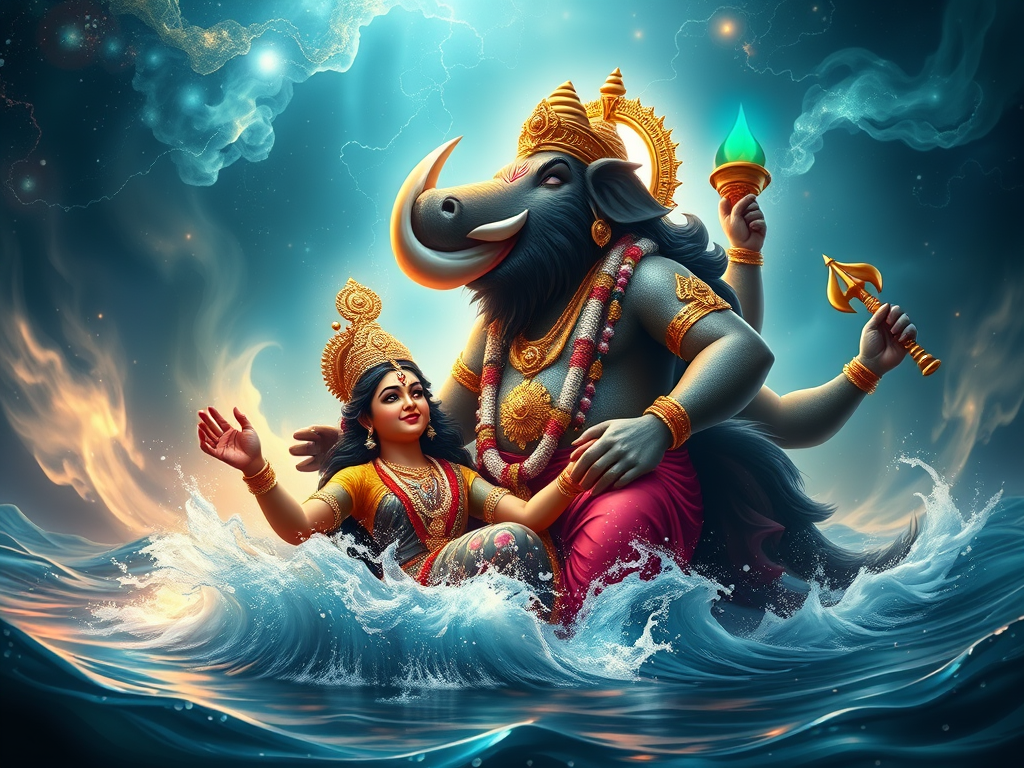
Among the revered Mahapuranas of Sanatana Dharma, the Varaha Purana shines with a deeply moving and compassionate spiritual voice. It is traditionally associated with the glory of Lord Vishnu, especially in His majestic form as Lord Varaha, the Divine Boar Incarnation who rescues the Earth from the cosmic waters and restores stability to creation. What gives this Purana a particularly tender and memorable beauty is its narrative setting. Rather than unfolding merely as a discourse among Sages, it is presented as a loving dialogue between the Divine Rescuer and Bhumi Devi, the Earth Mother whom He has just saved. In that setting, sacred teaching becomes an act of care. The Lord does not only restore the world outwardly; He also reveals the means by which the children of Earth may rise above sorrow, confusion, and bondage.
This devotional setting gives the Varaha Purana its special warmth. Bhumi Devi, grateful for deliverance and concerned for the welfare of living beings, asks how humanity may cross the ocean of worldly suffering. Lord Varaha responds not with distant abstraction, but with guidance filled with mercy, discipline, sacred observance, and hope. The result is a Dharmik Granth that speaks not only of salvation in the highest sense, but also of pilgrimage, conduct, vows, sacred places, and the steady refinement of the human heart. In this way, the Varaha Purana becomes a Guide for life itself: how to live with reverence, how to purify action, and how to orient the soul towards the saving grace of the Divine.
A Purana of Protection and Sacred Nearness
The image of Lord Varaha lifting Bhumi Devi from the cosmic waters is one of the most powerful sacred images in Hindu thought. It is more than a mythic act of restoration. It is a revelation of Divine concern for the world. The Earth is not abandoned in disorder, nor left unsupported in darkness. The Lord enters the struggle, lifts what has sunk, steadies what has trembled, and restores what seemed lost. This message alone makes the Varaha Purana profoundly meaningful for humanity. It teaches that when life feels submerged by fear, confusion, or moral decline, Divine Grace is still active, still rescuing, still upholding creation.
From that image of deliverance flows the entire mood of the Purana. The text is not merely interested in recounting wonders of the past. It seeks to show how human beings may also be lifted from the inner ocean of suffering. The demon overcome by Lord Varaha becomes, for the spiritual reader, a symbol of all forces that drag consciousness downward — ignorance, pride, greed, forgetfulness, and spiritual heaviness. The lifting of the Earth becomes a sacred assurance that no descent is final when the soul turns towards the Lord.
Structure, Sacred Teaching, and the Way of the Devotee
The Varaha Purana is traditionally described as a large Purana, often associated with around 24,000 verses and divided into two broad parts, the Purva Bhaga and the Uttara Bhaga. In its received form, it brings together cosmology, the glories of sacred places, stories of Avatars, ritual observances, Dharma, and practical guidance for devotees. This broad structure reflects a very important Hindu principle: spiritual life is not confined to philosophy alone. It must also enter pilgrimage, worship, fasting, conduct, remembrance, and charitable action.
The Purva Bhaga is often associated with the central dialogue, narratives of the Avatars, and the celebration of holy places. The Uttara Bhaga turns more strongly towards observance, rites, and ethical religious life. Together, these sections make the Varaha Purana both expansive and intimate. It can speak to the pilgrim, the worshipper, the householder, the scholar of Dharmik Vidya, and the seeker of liberation alike. Its wisdom is not reserved for a few. It is offered for the welfare of all.
The Mathura Mahatmya: The Lotus of the Earth
One of the most treasured features of the Varaha Purana is its strong connection with Mathura and the sacred Braj region. The text is remembered as one of the important ancient sources for the holiness of Mathura, Vrindavana, the forests, the ponds, and the wider sacred landscape associated with Lord Krishna. In this way, the Purana becomes not only a text of theology, but also a sacred map of devotion.
The description of Mathura as the “lotus of the Earth” is especially beautiful. The image suggests a land that is rooted in the world and yet spiritually elevated above impurity, just as a lotus rises untouched from the water. This sacred geography is not merely descriptive. It is transformative. Every forest, Kund, and step of pilgrimage becomes infused with spiritual significance. The land itself becomes a form of Divine Memory.
The instructions associated with Parikrama in this holy region reflect the Hindu understanding that movement through sanctified space can become an inward journey. The pilgrim walking through Mathura is not simply covering distance. The pilgrim is placing the body, mind, and heart into a rhythm of remembrance. Each step becomes an offering. Each pause becomes contemplation. Each sacred spot becomes a reminder that the Divine has touched the earth and made even geography a path of grace.
The glorification of Lord Keshava in Mathura also deepens this teaching. The worship of Lord Krishna in this sacred land is presented not merely as temple ritual, but as a direct spiritual opportunity. Other holy places may promise merit, but Mathura is cherished as a place where nearness to the Divine becomes especially immediate. In that sense, the Mathura Mahatmya teaches that sacred places are not remote abstractions. They are living centres of compassion, memory, and liberation.
Karma, Responsibility, and the Hope of Purification
A serious but spiritually valuable strand in the Varaha Purana is its treatment of Karma Vipaka, the unfolding results of human action. The text does not speak of Karma merely as a vague moral law. It presents life as ethically meaningful, where actions leave impressions and bear fruit over time. This teaching is deeply important for human civilisation, because it affirms that conduct matters. Speech matters. Intention matters. Action matters. Nothing is spiritually insignificant.
Yet the healthiest way to read this portion of the Purana is not through fear, but through responsibility and hope. The text’s deeper purpose is not to condemn the soul, but to awaken it. It teaches that suffering is not meaningless and that moral disorder has consequences, but it also insists that purification is possible. No stain is beyond repentance. No fallen state is beyond upliftment. Through Prayaschitta, sacred vows, charity, discipline, and sincere devotion, a person may begin again.
This is one of the most compassionate teachings in the Varaha Purana. It refuses both moral carelessness and hopelessness. It tells the reader: live carefully, because your life shapes your destiny; yet do not despair, because the Divine has opened paths of restoration. Such a message remains deeply relevant. In every age, people need both accountability and mercy. The Varaha Purana offers both.
The Sapta Matrikas and the Glory of Divine Power
The Varaha Purana also preserves the sacred story of the Sapta Matrikas, the Seven Divine Mothers. This narrative is especially significant because it shows the harmony of Vaishnava, Shaiva, and Shakta currents within the broader Hindu tradition. Though the Purana is associated with Lord Vishnu, it honours the manifestations of Shakti with dignity and reverence, showing that Divine Power works through many sacred forms.
The story of the Mothers appearing to assist in the defeat of destructive forces may be read as a profound lesson in Divine cooperation. Brahmani, Vaishnavi, Maheshwari, Kaumari, Varahi, Indrani, and Chamunda are not merely martial figures. They represent the many-sided power of the Divine Mother protecting the cosmic order. Their appearance teaches that when darkness multiplies, the Divine responds with corresponding forms of strength, wisdom, courage, and protective grace.
For humanity, the message is deeply uplifting. The world is not sustained by power alone, but also by Divine motherly force — nurturing when needed, fierce when necessary, and always dedicated to restoring balance. The inclusion of this sacred stream within the Varaha Purana broadens the heart of the text and shows that the preservation of the world depends upon the harmonious working of many aspects of the Divine.
The Story of Nachiketa and the Call to Dharma
The Varaha Purana also carries a Puranic retelling associated with Nachiketa, a figure already revered from the Katha Upanishad. In the wider sacred tradition, Nachiketa stands for fearless inquiry, purity of intention, and the human longing to understand death, truth, and the destiny of the soul. In the devotional framework of the Varaha Purana, this story serves as a moral and spiritual instruction for society.
The vision of realms of reward and suffering is best understood not as a spectacle, but as a teaching of consequence. The journey of Nachiketa reminds humanity that life is not morally empty. There is order, justice, and a deeper law governing action. To live in Dharma is to move towards harmony and light; to abandon Dharma is to create inner darkness. Thus the story does not seek to terrify. It seeks to awaken conscience.
That is why Nachiketa remains so beloved. He represents the soul that is willing to look beyond comfort, ask serious questions, and return with wisdom for the welfare of others. In this sense, the Varaha Purana transforms his story into a call for ethical seriousness, self-reflection, and reverence for the unseen consequences of human conduct.
Vratas of Lord Vishnu and the Sanctification of Time
A major practical gift of the Varaha Purana lies in its teachings on Vratas, especially those dedicated to Lord Vishnu. Sacred observances such as Dvadashi Vrat, Putrada Ekadashi, and Jayanti Vrat are treated not merely as ritual duties, but as means of inner refinement. In Hindu life, a Vrat is never only an abstention. It is a reordering of consciousness. Time itself is sanctified. Appetite is moderated. Speech becomes restrained. Memory turns towards the Divine.
The Varaha Purana gives these observances a beautiful devotional depth. Fasting is not presented as self-punishment, but as spiritual simplification. One withdraws from excess in order to make room for prayer, Japa, remembrance, and sacred listening. In that sense, the text teaches that the soul must be nourished even when the body is restrained. A true Vrat is fulfilled not by hunger alone, but by inward sweetness, discipline, and the Name of Narayana.
This is a profoundly humane teaching. It shows that holiness is not reserved for rare moments of dramatic revelation. It can be cultivated through recurring acts of devotion woven into the calendar of life. The household, the temple, the pilgrim, and the solitary devotee all find a place in such observances. Through Vrata, time becomes a teacher, and regularity becomes a path of grace.
Bhakti as the Supreme Secret
The final and perhaps most tender message associated with the Varaha Purana is its exaltation of Bhakti. After teaching about sacred places, conduct, vows, and the fruits of action, the Lord reveals the deepest secret: He is won not by outward complexity alone, but by loving devotion. This teaching gives the whole Purana its final sweetness. Yoga, discipline, sacrifice, and ritual all have their place, but the heart of the path is surrender filled with love.
This is what makes the Varaha Purana so spiritually consoling. It does not place salvation beyond the reach of ordinary people. It says, in effect, that the Lord is moved by sincerity. Tears of devotion, the singing of the Divine Name, reverence in the heart, and faithful remembrance have a power beyond outer status or show. This message joins the text beautifully with the wider current of Bhakti found across Puranas, Upanishadic thought, and the great devotional traditions of Bharat.
For humanity, this is an immense source of hope. The world may be troubled, the mind may be restless, and the age may be burdened by distraction, yet the path to the Divine remains open. A sincere heart, a sacred name, a disciplined life, and an attitude of surrender are enough to begin transformation.
The living message of the Varaha Purana is therefore radiant and compassionate: when the soul feels submerged, remember that the Lord still lifts. When the path seems uncertain, walk it through Dharma, pilgrimage, sacred observance, and remembrance. When the burden of past action weighs heavily, turn towards purification, not despair. When the mind seeks lasting refuge, seek it not in pride or possession, but in Bhakti. Then the same Lord Varaha who raised Bhumi Devi from the cosmic waters begins to raise the human heart as well — out of fear into trust, out of burden into devotion, and out of worldly confusion into the quiet strength of Divine grace.

Leave a Reply