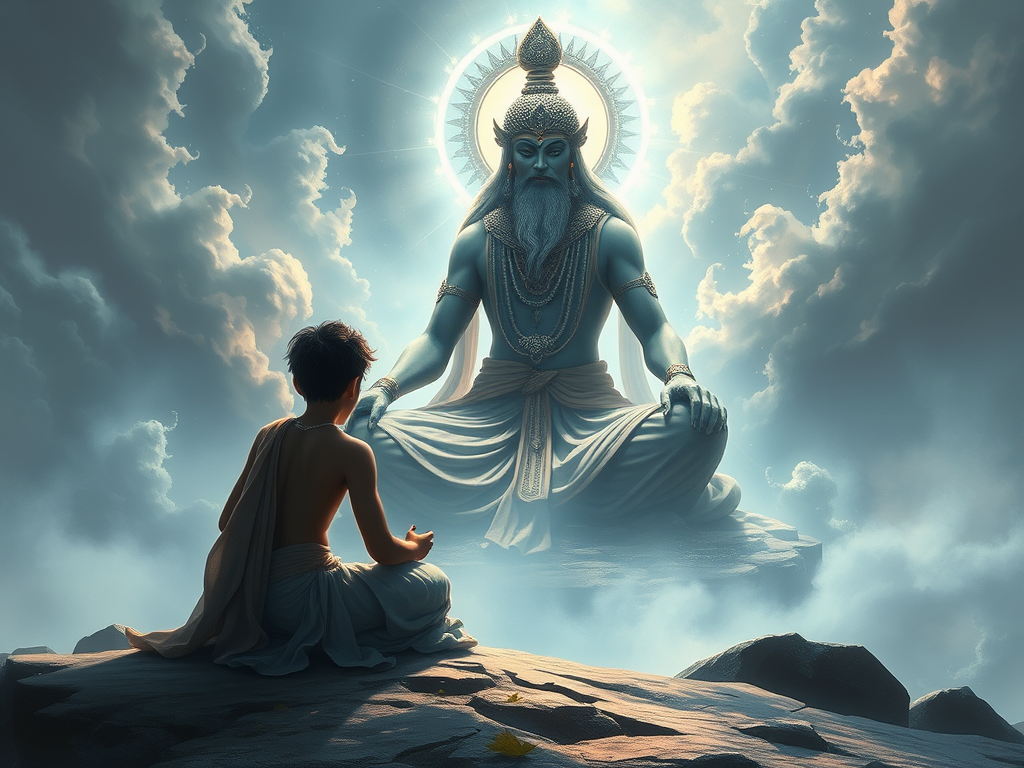
Among the most luminous Dharmik Granths of Sanatan Dharma, the Katha Upanishad holds a place of rare depth and beauty. It is traditionally associated with the Krishna Yajur Veda, and across its received text it unfolds as a profound Dialogue between Nachiketa and Lord Yama, turning the human fear of death into a doorway to Divine Wisdom. This is one reason the Katha Upanishad has remained so cherished through the centuries: it does not avoid the hardest question of human life, but approaches it with calmness, moral seriousness and spiritual radiance. It does not teach despair before death. It teaches that truth, when sought with purity, reveals the Eternal Self that is untouched by death.
The greatness of the Katha Upanishad lies first in its story. Many Sacred Texts speak in lofty declarations, but this Upanishad begins in a living household, in the midst of a sacrifice, where Dharma and sincerity are being tested. Vajasravasa, desiring spiritual merit, gives away his possessions, yet the text pointedly describes the cows being offered as worn out and useless. The young Nachiketa, still a boy, sees that something is wrong. His response is not insolence, but moral clarity. He understands that an outwardly sacred act loses its lustre when truth is missing from within it. Here the Upanishad offers humanity one of its earliest and strongest lessons: religion without sincerity cannot become true holiness. The Divine is not honoured by empty display, but by honest offering.
Moved by that truth, Nachiketa asks his father, again and again, to whom he himself will be given. In a moment of anger, the father replies that he gives the boy to Death. The force of the narrative lies in what happens next. Nachiketa does not collapse into resentment or fear. He honours the spoken word and proceeds to the Abode of Lord Yama. There he waits for three nights without hospitality while Yama is absent. When Yama returns, he recognises the gravity of a noble guest having been neglected and offers the boy three boons, one for each night he waited. The atmosphere here is deeply Dharmik: even in the Realm of Death, duty, honour and reverence remain binding. The Upanishad thus presents Death not as chaos, but as a realm still governed by order, justice and sacred responsibility.
The first boon asked by Nachiketa reveals his character at once. He does not begin with power, pleasure or escape. He asks that his father’s anger be calmed, that peace be restored, and that he be lovingly received again. In this first request, the Katha Upanishad gives a beautiful message for all humanity: before the seeker asks about heaven or liberation, he asks for harmony in the home. Spiritual greatness is not separated from filial reverence, reconciliation and tenderness. The second boon concerns the sacred fire that leads to heavenly good, which Yama teaches him with approval. Yet it is the third boon that makes the Upanishad immortal. Nachiketa asks the question that has accompanied mankind across every age: when a person dies, does the Self remain, or not? With that question, the story rises from moral beauty into spiritual splendour.
At first Lord Yama does not answer directly. He tests the boy. He offers him long life, wealth, cattle, horses, splendour, kingdoms, celestial enjoyments and all the glittering treasures that usually capture the human mind. But Nachiketa refuses them. He sees that pleasant things fade, that the vigour of the senses declines, and that even the longest earthly life remains brief before the Eternal. This moment is one of the noblest in all Upanishadic Literature. The boy does not reject the world out of bitterness. He rejects distraction because he has recognised something higher. He chooses Truth over temptation. He chooses what is lasting over what merely dazzles. Here the Katha Upanishad becomes a Sacred Mirror for human life: each person, in one form or another, stands before the same choice.
It is then that Yama unfolds one of the central teachings of the text: the distinction between Shreyas and Preyas. Preyas is the merely pleasant, what gratifies quickly and charms the senses. Shreyas is the truly good, what leads the Soul towards freedom, knowledge and lasting blessedness. The wise discriminate between the two; the unreflective cling to what is immediately pleasing. This teaching has never ceased to matter, because it describes the moral structure of daily life itself. Every age knows comfort, distraction, vanity and restlessness. Every age also knows duty, restraint, sacrifice and truth. The Upanishad does not deny pleasure, but it refuses to enthrone it. It teaches that real maturity lies in choosing what uplifts the Self, even when that path is more demanding.
The Katha Upanishad then gives one of the most memorable images in all Sacred Literature: the chariot teaching. The body is likened to a chariot, the senses to horses, the mind to the reins, the intellect to the charioteer, and the Self to the rider. The point is not merely poetic charm. It is a complete spiritual psychology. A life ruled by untrained senses and an unsteady mind cannot move towards peace. But when the intellect is discriminating and the mind is held with steadiness, the journey becomes ordered, purposeful and luminous. The image remains powerful because it speaks to every human being. It tells us that freedom does not come from abandoning life, but from governing it rightly. Inner discipline is not a denial of life; it is the art of making life worthy of the Soul that inhabits it.
This disciplined journey leads to the Upanishad’s central revelation: the nature of the Self. Yama teaches that the Atman is not born, does not die, and is not slain when the body is slain. It is eternal, ancient and abiding. Elsewhere the text describes the Purusha as “thumb-sized” and seated in the heart, a sacred image not of physical measurement in a crude sense, but of inward immediacy and contemplative presence. The same Self is said to be subtler than the subtle and greater than the great. Such language does not reduce the Divine Mystery; it trains the seeker to look beyond surface appearances. The message is one of immense consolation and strength: the deepest truth of a human being is not perishability, but immortality rooted in the Divine.
Because of this vision, the Katha Upanishad does not treat death as the final defeat of life. It treats death as a stern Teacher that can drive the mind inward towards the imperishable. The text speaks of a Reality beyond sound, touch, form and decay, knowing which one is freed from the mouth of death. Such verses give the Upanishad its unique spiritual dignity. It is not fascinated with endings for their own sake. It is concerned with awakening. The one who knows the Eternal does not become morbid, but fearless. Sorrow softens. Panic loses its command. Life itself becomes more sacred because it is no longer mistaken for the whole of existence.
This is also the setting in which the famous call resounds: “Arise! Awake! Approach the Great Ones and learn.” The path, the text says, is as difficult to tread as the sharp edge of a razor. This teaching is not meant to discourage the seeker, but to dignify the path. Spiritual life is not drift. It requires attention, humility, discipline and receptivity to true guidance. One must approach the Wise, learn carefully, and walk with vigilance. The greatness of the verse lies in its hope: the path is demanding, but it is open. Humanity is not abandoned to confusion. The way has been seen, walked and taught by the Great Ones.
Near its close, the Katha Upanishad speaks of the inner transformation by which the mortal becomes immortal. When the knots of the heart are cut, says the text, the human being attains the deathless state. This is a deeply beautiful expression. The knots are not merely intellectual doubts; they are the inward bindings of ignorance, fear, attachment and confusion. The Upanishad does not present liberation as a remote abstraction. It presents it as the flowering of the heart into freedom. Nachiketa, having heard this wisdom from Lord Yama, becomes the example of the ideal seeker: pure in intention, fearless in enquiry, restrained before temptation and unwavering before Truth.
That is why the Katha Upanishad remains ever fresh for humanity. It teaches that sincerity is greater than display, that discipline is kinder than indulgence, that wisdom is higher than wealth, and that the Self within is greater than all that time can take away. It teaches that the child who asks the right question may become greater than the powerful who never ask it. It teaches that even Death, when approached with courage and purity, may become a revealer of the deathless. And it teaches that a civilisation becomes nobler when it raises its young not merely to succeed in the world, but to choose Shreyas over Preyas, Truth over glitter, and the Eternal over the passing shadows that so often distract the human heart.
Leave a Reply