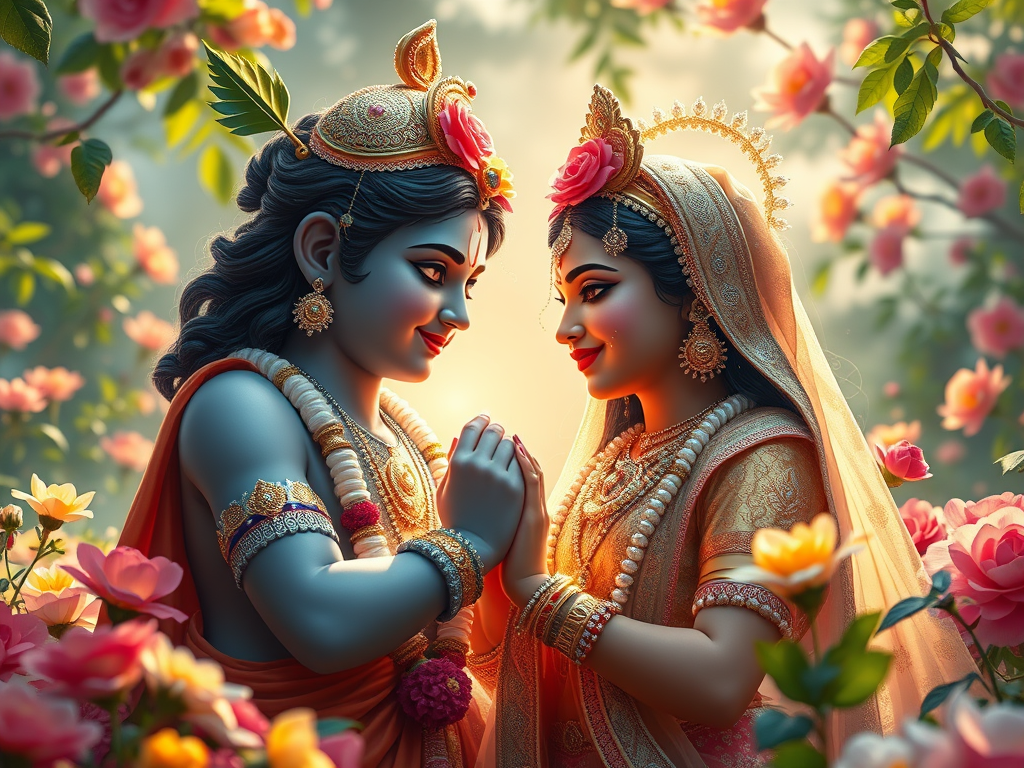
Among the great Dharmik Granths of Sanatana Dharma, the Brahmavaivarta Purana occupies a uniquely tender and spiritually elevated place. It is counted among the eighteen Mahapuranas and is especially cherished in traditions of Krishna Bhakti for its luminous vision of the universe as the living play of Lord Krishna and Shri Radha. The very name of the Purana carries profound philosophical meaning: Brahma signifies the Supreme Reality, and Vaivarta suggests manifestation, unfolding, or Divine expression. In this sacred vision, the universe is not distant from the Supreme; it is pervaded by Divine presence, animated by Divine energy, and made meaningful through Divine Love.
What distinguishes the Brahmavaivarta Purana is its deeply devotional way of presenting the highest Truth. Rather than speaking of the Supreme only in abstract language, it reveals the Absolute in intimate, beautiful, and relational form. Here, Lord Krishna is celebrated as the Supreme Purusha, and Shri Radha is honoured as the eternal Shakti, the primal Divine Energy through whom creation, beauty, love, compassion, and spiritual sweetness become manifest. This makes the Purana not only a theological text, but also a Guide to seeing the world itself as sacred, relational, and filled with the fragrance of Divine Love.
A Purana of Four Sacred Streams
The Brahmavaivarta Purana is traditionally divided into four Khandas: the Brahma Khanda, the Prakriti Khanda, the Ganapati Khanda, and the Shri Krishna Janma Khanda. Together, these four sections create a complete spiritual world. One speaks of creation and the supremacy of Lord Krishna; another glorifies the manifestations of the Divine Mother; another celebrates the sacred life of Lord Ganesha; and the largest section unfolds the sweetness, beauty, and transcendental significance of Shri Krishna’s Divine pastimes.
This structure itself carries a beautiful message. Sacred life is many-sided. It includes cosmology, devotion, worship of the Divine Mother, reverence for Lord Ganesha, and loving absorption in Krishna Bhakti. The Purana therefore does not limit the spiritual path to a single emotion or discipline. It offers a complete devotional universe in which wisdom, love, purity, family reverence, sacred story, and inward transformation all support one another.
Goloka: The Highest Realm of Divine Sweetness
One of the most distinctive and beloved teachings of the Brahmavaivarta Purana is its description of Goloka as the highest Divine realm. In this sacred vision, Goloka Vrindavana stands as the supreme abode of eternal beauty, higher even than other celebrated Divine realms, and shines as the world of pure love, joy, and nearness to Lord Krishna. It is portrayed not as a place of fearsome grandeur, but as a realm of forests, cows, music, affection, and endless sweetness, where the Supreme is experienced in intimate and loving form.
This is one of the Purana’s most tender spiritual contributions. It teaches that the highest reality is not merely power, distance, or abstraction. The highest reality is also sweetness, beauty, companionship, and Divine relationship. In Goloka, the soul is not lost in emptiness; it is fulfilled in love. Such a vision gives great solace to the human heart. It says that the deepest truth of existence is not coldness, but Divine nearness; not alienation, but belonging; not spiritual remoteness, but loving participation in the eternal presence of the Lord.
Shri Radha as the Eternal Divine Energy
Perhaps the most profound feature of the Brahmavaivarta Purana is the exalted place it gives to Shri Radha. Here, Shri Radha is not merely presented as a devotee among devotees, nor only as a beloved companion of Lord Krishna. She is honoured as the eternal and inseparable Divine Shakti, the original Prakriti, the living embodiment of love, grace, and sacred energy. Through her, Divine sweetness becomes accessible; through her, devotion becomes intimate; through her, the heart learns that the Supreme may be approached not only with awe, but also with affection and surrender.
This exaltation of Shri Radha carries immense devotional power. It means that Divine Love is not secondary in the cosmos; it is central. The world is not held together by force alone, but by the subtle power of grace, beauty, tenderness, and attraction towards the Divine. In this way, the Brahmavaivarta Purana teaches that love itself, when purified and divinised, is not a weakness but a revelation of the highest spiritual reality.
The relationship of Radha and Krishna in this Purana is therefore best read not in worldly terms, but as the sacred mystery of eternal Divine unity. Their inseparability becomes a teaching for the soul: the seeker should not separate the Supreme from Divine Compassion, nor truth from beauty, nor worship from love. Where Krishna is remembered, Radha’s grace is also present. Where Radha is adored, the path to Krishna becomes soft, intimate, and spiritually fruitful.
The Prakriti Khanda and the Glory of the Divine Mother
The Prakriti Khanda gives the Brahmavaivarta Purana a remarkable breadth by honouring several forms of the Divine Mother within a harmonious sacred framework. In the material you shared, this section presents five principal forms of Shakti — Radha, Durga, Lakshmi, Saraswati, and Savitri — each expressing a distinct yet interconnected dimension of Divine power. Read devotionally, this is not a division of the Supreme, but a flowering of one sacred feminine reality through many beneficent forms.
This teaching is spiritually rich and deeply humane. Human beings need different forms of Divine help: love, strength, prosperity, learning, protection, and sacred inspiration. The Purana responds to this need by showing the Divine Mother as many-sided yet essentially one. Durga gives courage and protection. Lakshmi blesses with abundance and harmony. Saraswati illumines knowledge and expression. Savitri sanctifies sacred wisdom. Radha reveals the summit of Divine Love. In this way, the Purana teaches that the Divine meets creation with fullness, not scarcity.
The stories associated with Tulsi Devi, Savitri, and Manasa Devi further widen this devotional world. These narratives are best approached as sacred illustrations of fidelity, purity, perseverance, healing, and the sanctification of devotion. They remind the reader that grace often enters life through steadfastness. A vow guarded with sincerity, a prayer sustained through difficulty, a life shaped by purity of intent — all these become doorways through which Divine blessing takes visible form.
Lord Ganesha in the Ganapati Khanda
The Ganapati Khanda offers another cherished dimension of the Brahmavaivarta Purana through its loving treatment of Lord Ganesha. Here, Lord Ganesha is presented in a specially elevated devotional light, connected closely with the grace of Lord Vishnu and ultimately with the wider Divine reality centred in Krishna. The narrative emphasises that the birth of Lord Ganesha is itself an act of Divine blessing, fulfilling the sacred longing of Goddess Parvati and sanctifying family life with joy and auspiciousness.
The account of Lord Ganesha’s elephant head, when read positively and devotionally, becomes a profound symbol rather than merely a startling event. It expresses transformation, renewal, and the fact that Divine identity is not diminished by outward change. Lord Ganesha stands forever as the remover of obstacles, the Divine Guide at the beginning of all noble undertakings, and the One whose wisdom is larger than ordinary perception. His form itself teaches humanity that spiritual greatness often appears in ways that transcend conventional expectation.
The story of Ekadanta, the One-Tusked Lord, carries a similarly beautiful message. In allowing the axe to strike out of reverence for the sacred, Lord Ganesha embodies humility, obedience, strength, and self-mastery. The narrative becomes a lesson in honour: true greatness does not always insist on victory, but often shines through restraint, reverence, and conscious sacrifice. For devotees, this makes Lord Ganesha not only adorable and auspicious, but morally instructive.
The Shri Krishna Janma Khanda and the Sweetness of Divine Love
The largest and most emotionally resonant part of the Brahmavaivarta Purana is the Shri Krishna Janma Khanda, which celebrates the life, pastimes, and transcendental sweetness of Lord Krishna. Here, the Purana dwells lovingly on the beauty of Krishna, the glory of Vrindavana, and the intimate sanctity of Radha-Krishna devotion. Unlike more restrained theological approaches, this text places special emphasis on Madhurya, the sweetness of Divine Love, and treats this sweetness as a supreme mode of spiritual realisation.
The importance of Shri Radha in this section is immense. The Purana teaches that Lord Krishna is most deeply known through her grace, and that the Divine relationship between Radha and Krishna is eternal, sacred, and spiritually foundational. The narrative of their secret wedding under the guidance of Lord Brahma is especially meaningful in devotional reading, because it affirms the eternal sanctity of their union. It tells the devotee that Divine Love is not momentary, accidental, or symbolic only in a limited sense; it is an eternal principle at the heart of reality itself.
The episodes of separation, longing, reunion, and remembrance should also be read with spiritual sensitivity. In Bhakti literature, separation is not merely sorrow; it intensifies remembrance and deepens the soul’s yearning for the Divine. Thus, when the Purana speaks of distance between Radha and Krishna in earthly play, it is also speaking to the human condition. The soul feels separated from the Lord, and that longing becomes the force that purifies, softens, and uplifts the heart. In this way, sacred longing itself becomes a path to grace.
Health, Balance, and the Care of the Body
A striking and often overlooked feature of the Brahmavaivarta Purana is its attention to bodily well-being. As your draft notes, the text includes discussion of disease, digestion, the Doshas, and proper routines of life. This is a significant reminder that Hindu sacred literature does not sharply separate spiritual life from physical balance. The body is not to be worshipped as an end in itself, nor neglected in carelessness. It is to be maintained as an instrument of Dharma, devotion, service, and self-discipline.
This integration is deeply valuable. A peaceful mind is supported by bodily moderation. Devotional practice is strengthened by health, purity, and rhythmic living. Food, hygiene, and discipline therefore become part of sacred life, not merely worldly concerns. The Purana suggests that the human being must seek wholeness: bodily balance, moral conduct, devotional feeling, and spiritual remembrance all belong together. Such a teaching remains highly relevant in modern life, where fragmentation often weakens both health and inward steadiness.
The Message of Purity, Love, and Spiritual Vision
The Brahmavaivarta Purana has sometimes been misunderstood when read without devotional sensitivity. Yet its deeper purpose is not to draw the mind towards material passion, but to elevate it towards Prema, Divine Love of the highest order. The love of Radha and Krishna is not meant to be reduced to ordinary worldly categories. It is the sacred mystery of Divine unity, attraction, joy, beauty, and spiritual fulfilment. Where material desire seeks possession, Divine Love seeks union in purity, surrender, and grace.
This is why the Purana remains so beloved among devotees. It tells the soul that the universe is not lifeless machinery, nor a cold abstraction, but the radiant unfolding of Divine relationship. Krishna is the Supreme Beloved, Radha is the eternal Divine Energy, and creation itself is touched by their play. To remember this is to begin seeing life differently — more tenderly, more reverently, and more spiritually. One begins to understand that beauty can be sacred, affection can be sanctified, and devotion can transform even ordinary existence into a field of grace.
And this is the lasting message of the Brahmavaivarta Purana for humanity: let the heart be purified until it can recognise Divine Love as the deepest truth of existence. Honour Shri Radha and Lord Krishna not only in worship, but in conduct shaped by tenderness, humility, purity, and compassion. Revere the Divine Mother in all her beneficent forms. Seek the blessings of Lord Ganesha at the beginning of every noble effort. Preserve bodily and moral balance as part of sacred living. Then the world itself begins to appear as it is in the vision of the Purana — not empty, not accidental, but quietly filled with the presence, beauty, and loving radiance of the Supreme.
Leave a Reply