Sacred Status
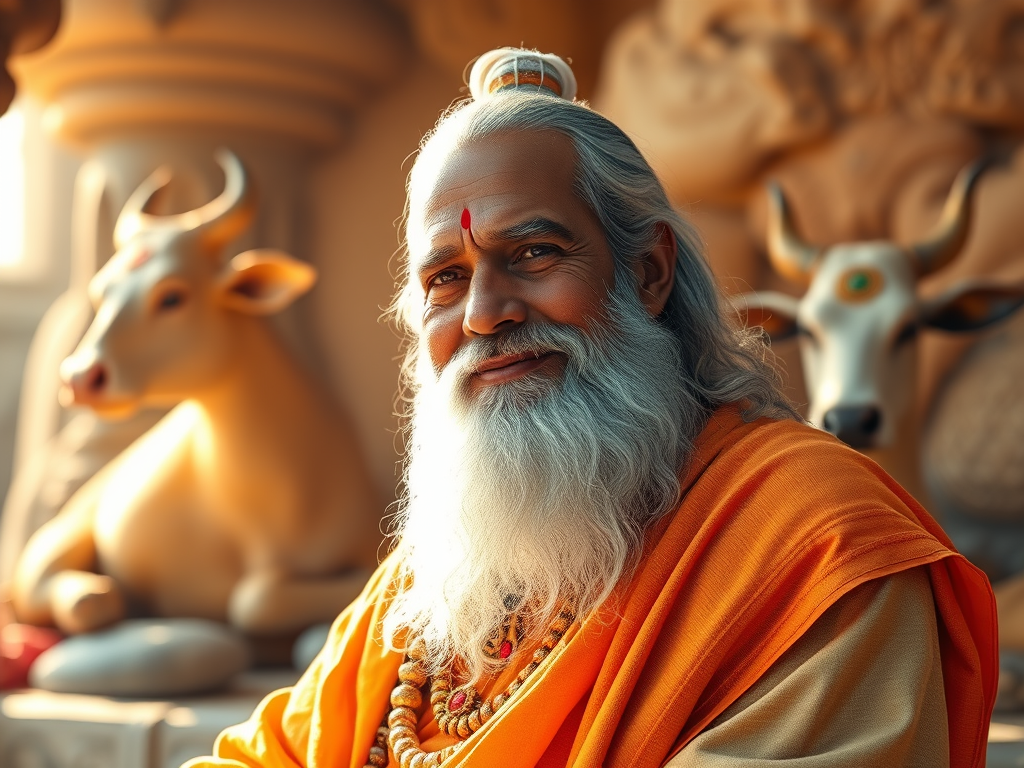
Maharshi Vashishtha holds one of the highest and most revered places in the spiritual heritage of Sanatana Dharma. He is remembered as one of the Saptarishis, the Seven Great Sages whose wisdom illumines the path of humanity across the ages. In sacred tradition, he is also honored as a Manasputra of Lord Brahma, a mind-born son born of divine knowledge and cosmic purpose. This alone places him among the most exalted rishis in Hindu thought.
Yet Maharshi Vashishtha is revered not only because of his origin, but because of his character. He stands as the embodiment of serenity, self-restraint, forgiveness, spiritual majesty, and unwavering knowledge of Truth. In a world where power is often measured by force, Vashishtha represents a higher power — the power of inner realization, discipline, and divine wisdom. He is remembered as a sage whose calmness could not be shaken and whose presence brought guidance, order, and spiritual depth to kings, seekers, and society alike.
For generations, Maharshi Vashishtha served as the Rajguru of the Suryavamsha, the great Solar Dynasty of Hindu tradition. From the earliest kings of that line to the age of Lord Rama, he remained a guiding light, shaping righteous kingship through spiritual wisdom. His role in the royal lineage reveals an important principle of Hindu civilization: that governance is strongest when guided by dharma, and that true rulers must be instructed by realized sages.
The Master of Brahmavidya
Maharshi Vashishtha is traditionally recognized as a Brahmarishi, the highest category of sage — one who has realized Brahman, the supreme and eternal reality. This title is not merely an honorific. It signifies the culmination of spiritual attainment, the state in which knowledge is no longer intellectual alone, but directly realized in the deepest truth of being.
What makes Vashishtha especially remarkable is the harmony of his wisdom and temperament. He is not remembered as a sage of harshness or volatility, but as one established in peace. His life teaches that the highest spiritual realization expresses itself not in pride or display, but in steadiness, compassion, and control over the senses. In him, knowledge becomes character. Realization becomes humility. Power becomes grace.
This is why Maharshi Vashishtha is often seen as the personification of Brahma-tejas, the radiance of spiritual power. His greatness lies not in worldly authority, but in his inner abundance. He possessed the divine cow Nandini, daughter of Kamadhenu, who symbolized not merely miraculous fulfillment, but the boundless richness of spiritual merit. In the symbolic language of dharma, Nandini represents the truth that the realized sage lives in alignment with divine abundance, where all necessary blessings arise naturally through purity and tapas.
The Symbol of Peace, Forgiveness, and Inner Strength
Among the most luminous qualities of Maharshi Vashishtha is his mastery over anger and sorrow. He is remembered as a sage whose inner balance remained unbroken even in the face of immense challenges. This is one of the reasons he occupies such a high place in Hindu spiritual imagination. He shows that true greatness is not only in knowing truth, but in living it under all circumstances.
In many sacred traditions, saints and sages are admired for miracles or scholarship. Vashishtha is admired equally for his forbearance. He teaches humanity that forgiveness is not weakness, but strength refined by wisdom. The one who has conquered the mind does not easily become disturbed by outer events. This ideal is especially important for society, because it reminds people that peace is not passivity. Peace is disciplined power under divine control.
For householders, leaders, teachers, and seekers, Maharshi Vashishtha remains a timeless example of emotional mastery. His life encourages patience in difficulty, calmness in conflict, and faith in the superiority of spiritual power over impulsive reaction. In this way, his example continues to speak not only to ascetics, but to the masses who seek stability and dignity in daily life.
The Conflict with Vishvamitra: The Triumph of Spiritual Power
One of the most well-known episodes associated with Maharshi Vashishtha is his sacred encounter with Vishvamitra, who at that time was King Kaushika. This episode is among the most meaningful in Hindu tradition because it is not simply a rivalry between two great figures; it is a profound teaching on the superiority of spiritual strength over worldly might.
When King Kaushika beheld the divine abundance present in Vashishtha’s ashram, especially through the grace of Nandini, he desired to possess that power by royal authority. But the sage did not respond with pride or aggression. Instead, he remained rooted in his own spiritual force. Through the power of the Brahmadanda, his sacred staff, the force of worldly weaponry was rendered powerless before realized wisdom. This moment has been treasured in tradition as a shining example of an eternal truth: Brahma-tejas is higher than Kshatra-tejas. Spiritual radiance surpasses military force, and inner realization exceeds external conquest.
This episode also serves a deeper spiritual purpose. It becomes the turning point in Vishvamitra’s own journey. What begins as a conflict eventually becomes a path of transformation. By witnessing the greatness of Vashishtha’s spiritual attainment, Vishvamitra is inspired to pursue tapas and rise from kingly power to sagehood. In this way, Vashishtha’s greatness does not merely defeat opposition — it uplifts it. Even conflict, in the hands of dharma, becomes an opportunity for inner awakening.
Compassion Beyond Injury and the Greatness of Forgiveness
The stories of Maharshi Vashishtha also highlight his extraordinary capacity for forgiveness. Even in the face of profound personal grief, he remains a model of restraint and spiritual composure. This aspect of his life is deeply moving because it shows a sage established in something far greater than personal reaction. He is not guided by vengeance, but by truth. He is not controlled by pain, but by realization.
This quality gives Vashishtha a unique place among the rishis. He demonstrates that forgiveness is not forgetfulness or passivity, but the flowering of a consciousness rooted in Brahman. The one who sees the eternal is not overwhelmed by the temporary. For this reason, he is remembered as a sage whose compassion was vast enough to transcend personal hurt.
The highest expression of this spirit appears in his relationship with Vishvamitra. When Vishvamitra’s long tapas matured and his transformation became complete, it was Maharshi Vashishtha who recognized and affirmed that greatness. This is a powerful lesson for humanity. The true sage is not threatened by the rise of another. He rejoices in spiritual progress wherever it appears. Vashishtha thus becomes a model not only of knowledge, but of spiritual generosity.
Maharshi Vashishtha as the Rajaguru of the Solar Dynasty
Maharshi Vashishtha’s role as the Rajguru of the Suryavamsha gives him immense importance in the moral and political imagination of Hindu tradition. He did not live apart from society in a way that ignored worldly life. Rather, he guided rulers so that power would remain aligned with righteousness. This shows the Hindu ideal that spiritual wisdom must help shape the life of the kingdom, the household, and the community.
As guru to the royal lineage, Vashishtha upheld the values of dharma, discipline, humility, and responsibility. He ensured that kings understood their duties not merely as rulers, but as protectors of cosmic and social order. This teaching remains relevant even today. Leadership, the life of Maharshi Vashishtha teaches, is sacred only when joined with self-control, justice, and reverence for truth.
His presence in the Solar Dynasty also connects him forever with Lord Rama, the supreme exemplar of righteous conduct. That Vashishtha served as guide within that divine lineage reveals the greatness of his spiritual station and the trust placed in him by sacred history.
The Guru of Lord Rama
One of the most spiritually significant dimensions of Maharshi Vashishtha’s life is his role as the teacher of Lord Rama. In the Ramayana tradition, Vashishtha is not merely a court priest or advisor. He is a true guru, one who helps reveal the highest knowledge needed for both inner realization and righteous action.
When the young Rama becomes reflective and inwardly detached from worldly appearances, it is Maharshi Vashishtha who offers the deeper wisdom needed to integrate spiritual insight with worldly duty. This teaching tradition becomes associated with the profound text known as the Yoga Vashishtha, one of the great treasures of Hindu philosophical literature.
In guiding Rama, Vashishtha teaches an eternal truth of Sanatana Dharma: that the highest spirituality does not demand escape from responsibility, but transformation of consciousness within responsibility. A person may fulfill duties in the world while remaining inwardly unattached, serene, and established in truth. This teaching is immensely valuable for the masses, because it shows that liberation is not reserved only for those who withdraw from life. Even while living, serving, and acting, one may walk the path of wisdom.
The Philosophy of Yoga Vashishtha
The wisdom associated with Yoga Vashishtha occupies a special place in Hindu philosophy. It presents a deeply contemplative vision of reality, mind, illusion, and liberation. Maharshi Vashishtha teaches that the world as ordinarily experienced is shaped by the movements of the mind. When the mind is restless, bound, and clouded by illusion, the world appears fragmented and burdensome. When the mind is purified and illumined, reality is understood in its deeper unity and sacred nature.
This teaching does not deny the world, but calls for a transformation in the way it is seen. Vashishtha leads Rama toward inner freedom by revealing the role of chitta, maya, detachment, self-inquiry, and realization of the Self. In this vision, liberation is not merely a future state, but a shift in consciousness. The wise person lives in the world like a lotus untouched by the water around it — fully present, yet inwardly free.
Such teachings make Maharshi Vashishtha one of the greatest spiritual philosophers of Hindu tradition. His wisdom is lofty, yet practical. It does not remove a person from life, but teaches how to live with clarity, steadiness, and divine awareness. This is why his message continues to attract seekers, thinkers, and devotees across generations.
Relevance to Hindu Faith and the Wider Masses
Maharshi Vashishtha remains deeply relevant not only to spiritual seekers, but to society at large. In an age of restlessness, his life teaches calmness. In a world of ego-driven competition, he teaches the dignity of inner wealth. In times of anger and division, he teaches forgiveness and restraint. In moments of confusion, he teaches wisdom joined with duty.
For Hindu faith, he stands as one of the purest examples of what a rishi truly is — not merely a thinker, but a realized being whose life itself is scripture. For families, his example teaches the importance of discipline, reverence, and values-based guidance. For leaders, he teaches that true authority must bow before dharma. For the masses, he offers a message of hope: that peace, self-mastery, and divine understanding are possible even amid the demands of life.
His legacy continues through the Ramayana tradition, through the philosophical light of Yoga Vashishtha, and through the enduring memory of a sage who placed truth above power and peace above reaction. He remains one of the great pillars of India’s spiritual civilization.
Conclusion: The Eternal Light of Maharshi Vashishtha
Maharshi Vashishtha is one of the most majestic and inspiring sages in all of Hindu tradition. He embodies the union of wisdom and humility, power and peace, knowledge and compassion. As Saptarishi, Brahmarishi, Rajaguru, and Guru of Rama, he stands at the meeting point of sacred knowledge and righteous living.
To remember Maharshi Vashishtha is to remember that the highest strength is inner strength, that true abundance is spiritual abundance, and that the light of realized wisdom can guide both kings and common people alike. His life continues to teach humanity that peace is powerful, forgiveness is noble, and the path of dharma shines brightest when illuminated by self-knowledge.
For all who seek serenity, guidance, and the eternal wisdom of Sanatana Dharma, Maharshi Vashishtha remains an immortal source of inspiration.
Leave a Reply