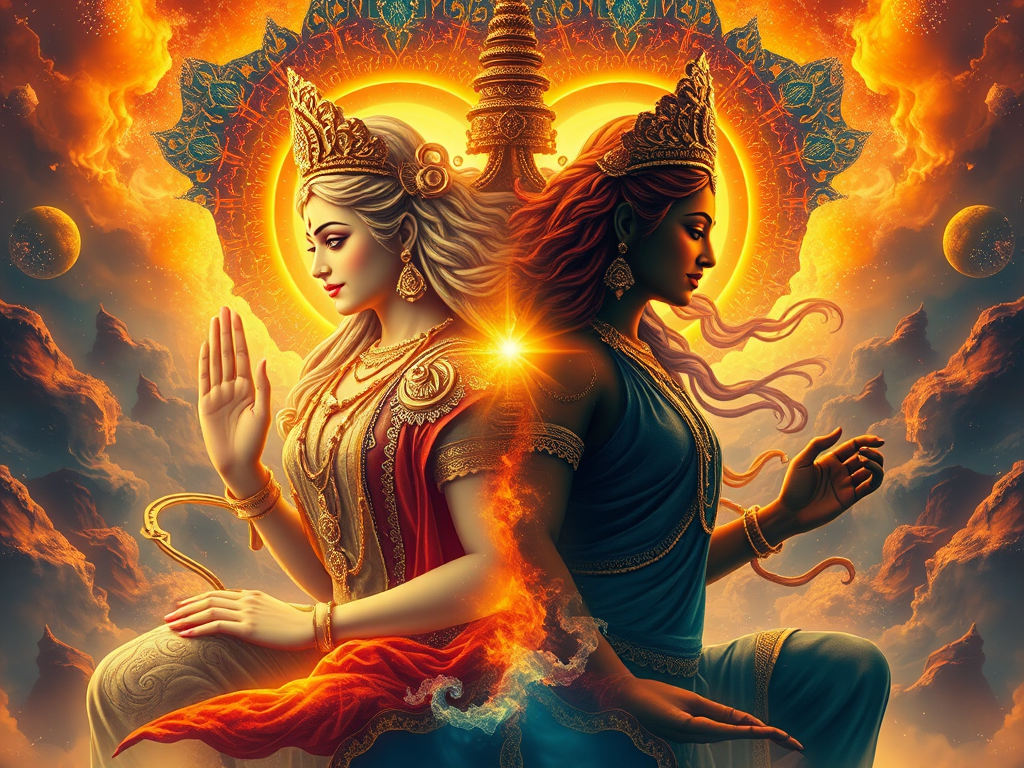
In the vast and profound world of Sanatana Dharma, creation is often understood not merely as a physical event, but as a living expression of divine principles. The universe is sustained through balance — light and shadow, expansion and contraction, harmony and struggle, grace and effort. Among the many sacred figures who embody these truths, Aditi and Diti, the wives of Sage Kashyapa Prajapati and daughters of Daksha Prajapati, hold a deeply meaningful place. Their stories are not only about lineage, but about the spiritual forces that shape the cosmos and the human heart.
Aditi and Diti are remembered in Hindu tradition as the mothers of two great streams of beings — the Adityas and the Daityas. Yet their significance goes far beyond genealogy. Together, they represent two dimensions of existence that are present throughout creation and within every human life. Aditi reflects boundlessness, purity, divine protection, and the sustaining force of cosmic order. Diti reflects power, intensity, ambition, individuality, and the dynamic energies that test, challenge, and ultimately deepen spiritual understanding. Seen in this way, their stories become timeless teachings on the need for balance, self-mastery, and divine alignment.
The name Aditi carries a profound spiritual meaning. It is often understood as “the unbound,” “the limitless,” or “the infinite.” In the Vedic vision, Aditi is not only a mother of celestial beings, but also a symbol of vastness, freedom, nourishment, and sacred protection. She is associated with the open and luminous dimension of existence — the divine order that supports life, truth, and harmony. In many traditional interpretations, Aditi represents the spirit of expansiveness that allows goodness, clarity, and righteousness to flourish.
As the mother of the Adityas, Aditi is linked with the forces that uphold cosmic balance. The Adityas are associated with divine radiance, moral order, and protection of the universe. Through them, Aditi becomes a symbol of the nurturing side of creation — the aspect that sustains truth, guards righteousness, and supports the welfare of all beings. In this sacred lineage, Hindu thought presents a beautiful vision of motherhood not only as biological care, but as a cosmic principle of protection, stability, and benevolence.
Among the many revered associations connected with Aditi, one of the most beloved is her connection to Lord Vishnuin the Vamana Avatar. In this sacred narrative, Aditi is remembered for her deep devotion, maternal concern, and unwavering faith in divine grace. Through prayer, discipline, and spiritual dedication, she turns to the Lord for the restoration of balance in the universe. Her devotion becomes a shining example of how faith, humility, and sincerity invite divine intervention. In this way, Aditi is not only a mother of devas, but also a model of prayerful strength and spiritual trust.
Philosophically, Aditi represents the sattvic dimension of existence — purity, peace, clarity, and truth-centered living. She reflects the state of consciousness in which the mind expands toward compassion, wisdom, and divine order. For spiritual seekers, Aditi can be seen as the inner space where devotion grows, fear dissolves, and the soul remembers its connection to the Infinite. Her symbolism remains deeply uplifting because it reminds humanity that the highest path is one of openness, grace, and alignment with dharma.
In contrast, Diti represents another essential aspect of cosmic reality. If Aditi is the limitless, Diti is often understood as the bounded or differentiated. She is associated with intensity, form, force, and the powerful energies that move through material existence. In Hindu thought, such energies are not meaningless or outside the divine order. Rather, they are part of the larger cosmic play through which the soul learns discernment, discipline, and transformation. Diti therefore represents not merely opposition, but the challenging dimensions of life that demand inner strength and spiritual maturity.
As the mother of the Daityas, Diti is associated with beings of great power, ambition, and force. In devotional and philosophical readings, this lineage often symbolizes the tendencies of ego, control, and worldly intensity that can disturb harmony when left unchecked. Yet Sanatana Dharma rarely presents such forces in simplistic terms. Even the most difficult energies in creation are part of a deeper spiritual pattern. They test righteousness, awaken courage, and reveal the need for divine guidance. In this sense, Diti’s role in sacred literature is profoundly instructive. She represents the truth that power without inner balance can create turbulence, but power transformed through wisdom can become a force of growth.
The stories connected with Diti often carry important lessons about timing, discipline, intention, and purity of mind. Rather than reading them only as narratives of conflict, they may also be understood as reminders that states of consciousness influence the quality of what is created in life. When the mind is restless, driven, or disturbed, the results often bring struggle. When the mind is purified and aligned with dharma, even intense energies can be redirected toward higher purpose. This is one of the enduring spiritual messages contained in the stories of Diti.
A particularly meaningful and hopeful aspect of Diti’s tradition is the story connected with the Maruts. In this sacred narrative, what begins as a force shaped by pain and anger is ultimately transformed into a divine expression within the cosmic order. The Maruts, associated with vitality, movement, and storm-like energy, show that not all intense forces are to be rejected. When touched by divine influence and purified through spiritual process, even turbulent energy can find its proper place in creation. This is a deeply encouraging message for humanity. It teaches that no energy is beyond transformation, and that with grace, discipline, and inner correction, struggle itself can become part of spiritual evolution.
Together, Aditi and Diti reveal a profound truth about the human condition. Every person carries within them both the aspiration toward light and the pull of limitation. There is the part of the self that seeks truth, devotion, compassion, and higher purpose, and there is also the part that seeks control, possession, recognition, and separation. The wisdom of Sanatana Dharma does not deny this duality. Instead, it teaches how to understand it, refine it, and ultimately bring life into harmony with the divine. That is why these sacred figures remain so meaningful. Their stories are cosmic, but they are also deeply psychological and spiritual.
For Hindu faith, the narratives of Aditi and Diti are valuable not only because they explain sacred lineages, but because they illuminate the structure of existence itself. They show that creation includes both sustaining and challenging forces, and that the journey of life is not to escape this complexity, but to navigate it with dharma. Through Aditi, one learns trust, purity, surrender, and divine protection. Through Diti, one learns the consequences of imbalance, the power of inner correction, and the possibility of transformation. Together, they teach that spiritual maturity comes not from denial of life’s tensions, but from understanding them in the light of divine truth.
These teachings also hold great relevance for society. In family life, community life, and personal conduct, human beings constantly encounter the need to choose between higher and lower tendencies. Patience or anger, humility or pride, service or selfishness, faith or fear — these choices shape individual destiny and social harmony. The sacred stories of Aditi and Diti remind people that the light of dharma must be consciously nurtured. They encourage humanity to cultivate sattva, self-discipline, devotion, and noble intention, while also recognizing and transforming the restless and ego-driven impulses that disturb peace.
For the masses, this makes the stories especially powerful. They are not abstract philosophical ideas meant only for scholars. They are living spiritual lessons. Aditi becomes a symbol of the motherly, protective, expansive force of grace that every family can revere. Diti becomes a symbol of the intense struggles, emotions, and ambitions that every human being must learn to purify. Their stories teach that life is a field of inner refinement, and that divine wisdom helps transform confusion into clarity.
The spiritual beauty of these narratives lies in their completeness. Sanatana Dharma does not present the universe as one-dimensional. It recognizes that growth often occurs through contrast, that wisdom arises through discernment, and that divine order includes both gentle nourishment and powerful testing. In this larger vision, Aditi and Diti are not merely opposite figures; they are complementary dimensions of a sacred reality that ultimately leads the soul toward understanding.
That is why the story of Aditi and Diti remains a meaningful part of Hindu sacred tradition. It is a story of cosmic motherhood, divine order, inner struggle, and spiritual balance. It teaches that light must be protected, strength must be purified, and all forces of life must be aligned with dharma. Through these two great mothers, humanity is invited to reflect on its own inner world and to walk the path of truth with greater awareness.
To contemplate Aditi and Diti is to enter a deeper understanding of creation itself. One represents the limitless grace that uplifts the soul, while the other reveals the intensity that must be transformed through wisdom. Together, they offer a timeless lesson: that life finds harmony when power is guided by purity, and when the soul turns steadily toward the Divine.
Leave a Reply