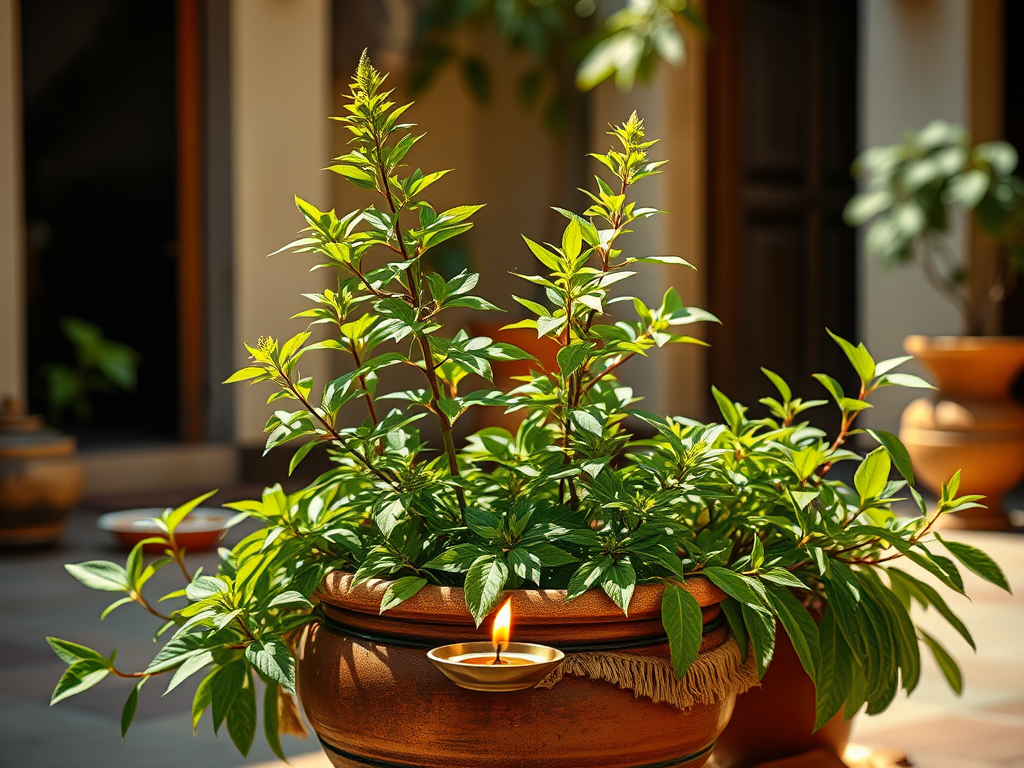
Indian civilisation has always understood that sanctity does not dwell only in temples and texts. It also grows in courtyards, earthen pots, and leaves touched by prayer. Tulsi and bel patra are among the most beloved examples of this marriage between botany and devotion.
Tulsi is cherished as a plant of purity, grace, and protective domestic presence. It is deeply associated with Vishnu and Lakshmi in the devotional imagination, and its presence near the home brings with it a habit of daily care, watering, lamp-lighting, and remembrance. A house that tends Tulsi learns rhythm.
Bel patra belongs especially to Shiva. Its trifoliate form carries theological richness, and in ritual use it becomes more than foliage. It is a leaf of offering, austerity, and concentrated reverence. To place bel patra upon the Shivling is to join nature and worship in one humble gesture.
Vastu does not treat such plants merely as decorative greenery. Tulsi is best kept where it receives healthy light and where the household can honour it with regularity. It should not be hidden in an ignored corner. Bel, being a tree rather than a small domestic plant in the usual sense, belongs more to the devotional and ritual economy than to the compact urban balcony, though its leaves remain central in Shiva worship.
Mathematically, Tulsi speaks of daily repetition, while bel patra speaks of the sacred three. Together, they show that Indian domestic life has long woven spiritual meaning into the living world. A home with sacred plants is not simply beautified; it is softened.
| Sacred plant | Traditional association | Practical role |
|---|---|---|
| Tulsi | Vishnu, Lakshmi, domestic purity | Daily worship and calm atmosphere |
| Bel patra | Shiva | Essential leaf in Shiva worship |
| Symbolic number | Bel patra’s three leaves | Sacred triads and completeness |
| Home value | Living devotion | Encourages daily care and reverence |

Leave a Reply