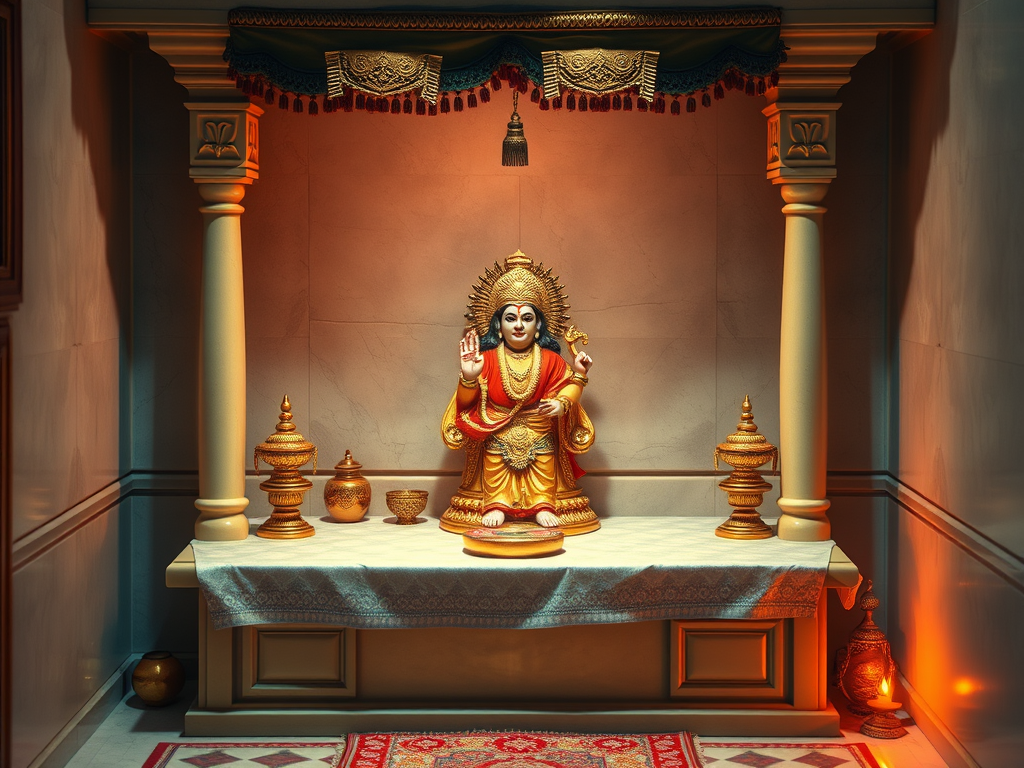
A home mandir should not try to behave like a public temple. Domestic worship thrives on proportion. Traditional guidance for household icons prefers smaller murtis, and one respected domestic rule describes an agreeable home image as approximately mushti-size—roughly the measure of one’s own fist with the thumb raised. This is not meanness of scale. It is devotional realism. What lives in the home must be worshipped daily, bathed mentally or ritually, dressed, adorned, and remembered without strain.
Many families also ask whether deity images should be placed above the main entrance. The more refined practice is to distinguish between threshold auspiciousness and inner worship. A toran, sacred symbol, or graceful protective motif belongs naturally to the doorway. The deity, however, deserves sheltered reverence. Inside placement is often nobler than weather-beaten display outside. The threshold may welcome fortune; the altar should host presence.
Then comes the cloth. In ritual language, vastram is not decoration but offering. In the sixteenfold order of puja, cloth is part of the hospitality extended to the divine after bathing and honouring the murti. Hence the cloth beneath or around the altar must be clean, fresh, and intentional. A dusty or crumpled altar cloth silently injures the shrine’s dignity. The sacred is not diminished by simplicity; it is diminished by carelessness.
Common defects and remedies
| Defect | Why it matters | Practical remedy |
|---|---|---|
| Oversized murtis in a tiny flat | Hard to maintain and visually heavy | Prefer smaller, manageable icons |
| Too many gods crowded together | Weakens focus | Keep one principal centre and balanced supporting forms |
| Deity image exposed outside | Dust, heat, neglect | Use inner placement; keep entrance symbolism lighter |
| Dirty altar cloth | Reduces reverence | Replace or wash regularly |
| Mandir mixed with bills, chargers, storage | Dilutes sanctity | Create a clean devotional boundary |
The principles above draw on domestic shrine practice and the older logic of ritual hospitality.

Leave a Reply