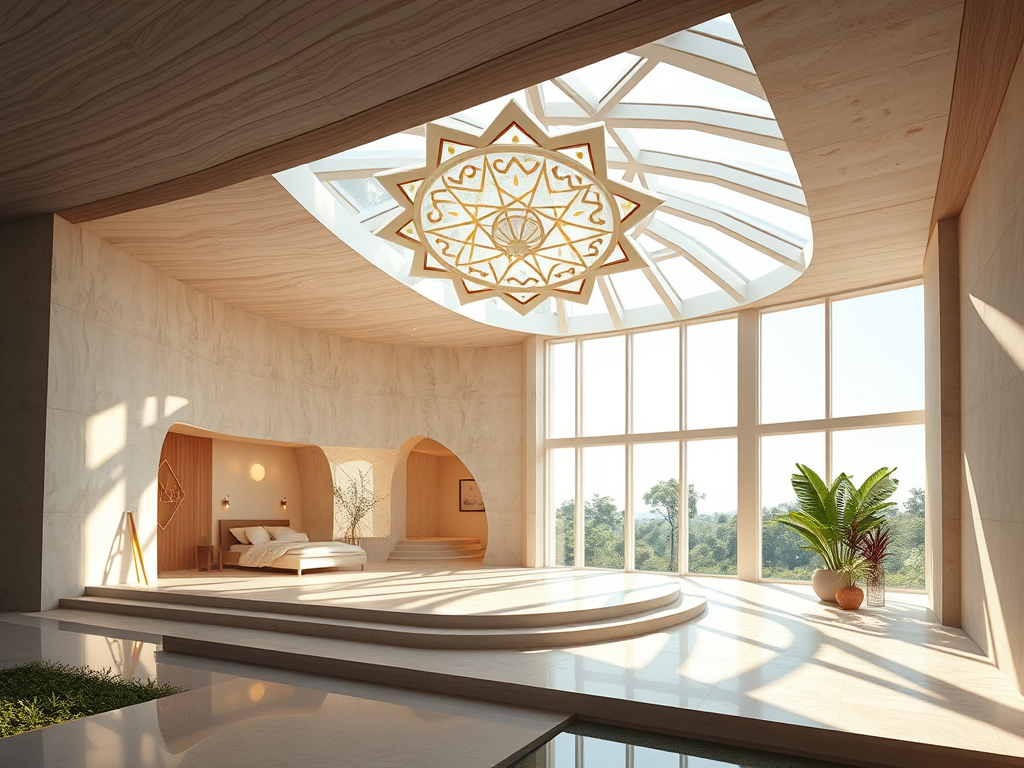
Vastu Shastra has not survived merely as a relic of reverence. It has endured because it can still converse with modern architecture. Its principles of orientation, climatic sensitivity, spatial hierarchy, and energetic balance have found renewed life in contemporary design, particularly in the work of visionary Indian architects.
Charles Correa stands among the most eloquent interpreters of this inheritance. He did not reduce Vastu to mechanical superstition. Rather, he treated it as an architectural method capable of generating meaningful and regionally rooted form. His Jawahar Kala Kendra in Jaipur offers a luminous example. The building draws upon the Navagraha mandala, with each square corresponding to a planet and housing functions aligned with planetary character. The result is not an antiquarian imitation but a deeply intelligent synthesis of symbolism, civic purpose, and spatial order.
Balkrishna V. Doshi approached the tradition with similar seriousness and freedom. A Pritzker laureate, he recognised in Vastu a flexible framework rather than a rigid code. In projects such as Vidyadhar Nagar, he embraced its respect for light, ventilation, local materials, and climatic fitness. This is precisely where Vastu meets sustainability. Long before contemporary discourse coined its preferred terms, Vastu was already concerned with solar response, air movement, and environmental compatibility.
This affinity with sustainable design is one of Vastu’s strongest modern credentials. Eastward openness, controlled western exposure, balanced zoning, breathable centres, and climate-aware planning all support energy efficiency and human comfort. Such measures reduce excessive heat, improve natural illumination, and create more humane interiors. Vastu, in this sense, is not opposed to modernity. It is one of the older languages through which sustainable modernity can be expressed.
Its relevance extends beyond prestigious architecture. Luxury interiors, urban planning, corporate design, and residential projects increasingly draw upon Vastu because people continue to seek spaces that feel balanced as well as efficient. A workspace aligned for concentration, a home designed for peace, a neighbourhood planned with attention to light and movement—these are not archaic desires. They are modern necessities.
The future of Vastu lies not in blind repetition but in intelligent interpretation. As environmental psychology and biophysical thinking continue to explore the impact of built space on human behaviour, ancient insights about orientation, openness, and spatial rhythm are gaining fresh dignity. Vastu survives because it addresses a permanent question: how shall we build so that life within the structure becomes richer, calmer, and more resilient?
Its answer remains quietly powerful. Build with the sun in mind. Build with the earth’s force in mind. Build with the human spirit in mind. Then architecture ceases to be mere construction and becomes a generous art of living.
| Modern figure / idea | Vastu-based interpretation | Present-day significance |
|---|---|---|
| Charles Correa | Used Vastu as a design methodology | Preserved cultural logic in modern public architecture |
| Jawahar Kala Kendra | Planned through the Navagraha mandala | Joined symbolism with functional design |
| B. V. Doshi | Treated Vastu as flexible guidance | Proved its adaptability in contemporary planning |
| Vidyadhar Nagar | Climate-aware, Vastu-informed layout | Linked tradition with sustainable urbanism |
| Sustainable architecture | Natural light, ventilation, local suitability | Shows Vastu’s continuing practical relevance |
Leave a Reply