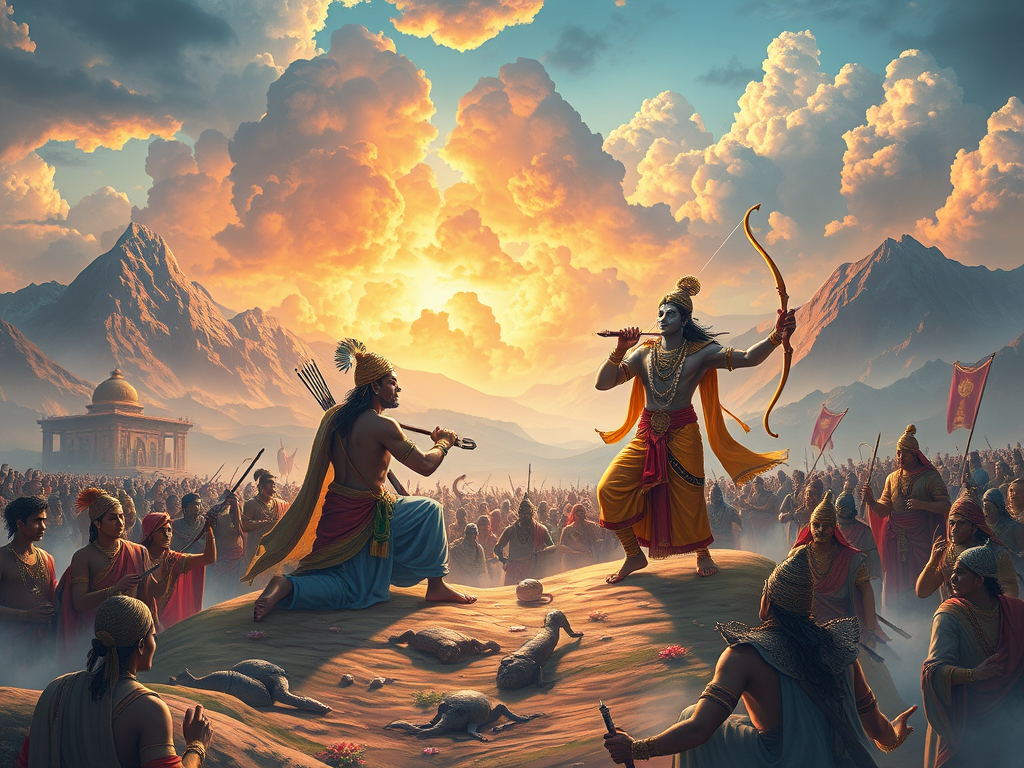
Shrimad Bhagavad Gita
Often referred to simply as the Gita, this 700-verse scripture is part of the Bhishma Parva of the Mahabharata. It is a dialogue between Prince Arjuna and Lord Krishna on the battlefield of Kurukshetra. The Gita does not just discuss war; it is a profound treatise on Dharma (duty), Karma Yoga (path of selfless action), Bhakti Yoga (path of devotion), and Jnana Yoga (path of knowledge). It teaches that the soul (Atman) is immortal and that one must perform their duty without attachment to the results.
Ramayana
Authored by Maharshi Valmiki, the Ramayana is the “Adi Kavya” (first poem). It chronicles the life of Lord Rama, the Prince of Ayodhya. It consists of 24,000 verses divided into seven Kandas (books). It establishes the ideal of the “Maryada Purushottam” (the ideal man) and explores relationships—ideal king, ideal son, and ideal brother.
Mahabharata
Written by Ved Vyasa, this is the longest epic poem in the world, containing over 100,000 verses. It narrates the struggle between two groups of cousins, the Kauravas and the Pandavas, for the throne of Hastinapura. It is famous for the saying, “What is found here may be found elsewhere; but what is not here is nowhere else.” It is a complex study of politics, psychology, and the four goals of life (Purusharthas).
Ramcharitmanas
Composed by the 16th-century poet-saint Tulsidas in the Awadhi language, this text makes the story of Rama accessible to the common man. Unlike Valmiki’s depiction of Rama as an ideal human, Tulsidas emphasizes Rama as the Supreme Deity (Brahman). It is a masterpiece of the Bhakti movement.
Shrimad Bhagavata Purana
This is one of the eighteen great Puranas (Mahapuranas). It focuses on Bhakti (devotion) to Lord Vishnu and his avatars, particularly Lord Krishna. Its 10th Canto, which describes the childhood and pastimes (Leelas) of Krishna, is the most celebrated section. It emphasizes that devotion is superior to ritualistic knowledge.
Leave a Reply