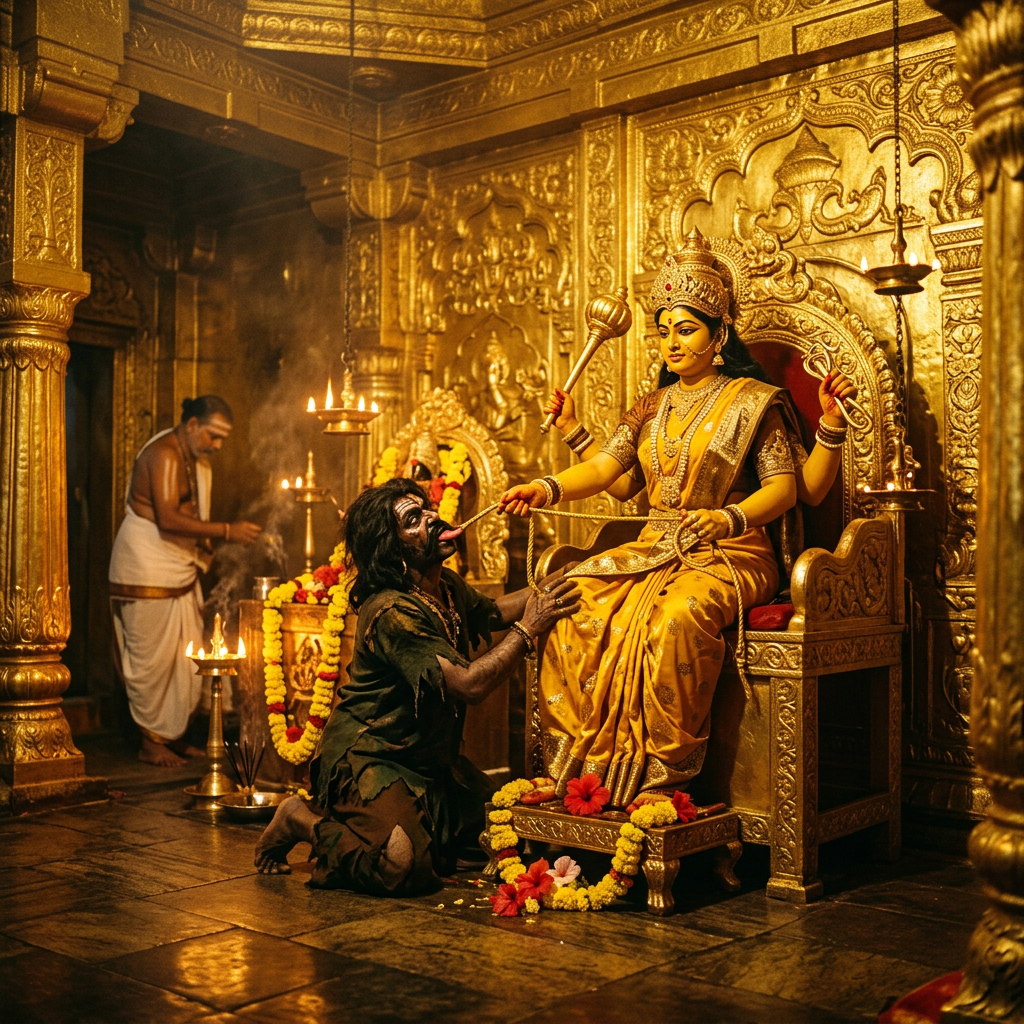
Dasha Mahavidya Context
| Mahavidya | Broad Spiritual Principle |
| Kali | Time, transformation, ego-dissolution |
| Tara | Compassionate rescue, crossing over |
| Tripura Sundari | Beauty, bliss, Sri Vidya wisdom |
| Bhuvaneshwari | Cosmic space, universal motherhood |
| Bhairavi | Tapas, fierce spiritual discipline |
| Chhinnamasta | Self-offering, radical transcendence |
| Dhumavati | Detachment, wisdom through emptiness |
| Baglamukhi | Stilling harm, restraint, protection |
| Matangi | Sacred speech, inner refinement |
| Kamala | Auspicious abundance, lotus grace |
Maa Baglamukhi is commonly revered as the eighth of the Dasha Mahavidyas, the Ten Great Wisdom Powers of the Divine Mother. In Shakta understanding, the Mahavidyas are not “separate Goddesses” in a fragmented sense. They are ten Divine Windows into the one Adi Parashakti — fierce, tender, silent, luminous, terrifying to adharma, and endlessly protective to the surrendered heart.
The Brihaddharma Purana and Mahabhagavata Purana are often cited in the Shakta tradition for the Mahavidya framework, especially the narrative in which Devi manifests multiple sovereign forms. Available traditional references and studies preserve Baglamukhi among the ten Mahavidyas, alongside Kali, Tara, Tripura Sundari, Bhuvaneshwari, Bhairavi, Chhinnamasta, Dhumavati, Matangi and Kamala.
Her name is explained in several ways. One devotional interpretation relates Her to Valga, the bridle — the power that reins in destructive movement. Another sees Her as the Devi who stills the mouth, tongue, speech and hostile intention. Hence Her worship is especially connected with the ethics of speech. A devotee of Baglamukhi must ask: are my words sattvic? Are they useful? Are they truthful? Are they restrained?
In the Todala Tantra and related Shakta-Tantric streams, Baglamukhi is contemplated as yellow-robed, radiant, three-eyed, adorned with yellow ornaments, and associated with the power to paralyse harmful forces. Modern repositories preserving Baglamukhi dhyana traditions note this yellow-golden iconography and Her relationship with Maharudra in certain Tantric descriptions.
Yet Her worship is not merely external. If Kali cuts ego, Tara ferries across fear, and Tripura Sundari reveals beauty, Baglamukhi stops the inner saboteur. She halts the restless tongue. She stills the unsteady mind. She makes the devotee wait before reacting. In family life, that is grace. In public life, that is wisdom. In sadhana, that is a doorway to silence.